


Indianapolis Motor Speedway Museum : A walk through the renovation


The first thing you feel isn't a car. It's speed. But it starts quietly.
You come in through the lobby, and the lights begin to move. A show-lighting effect washes the space in streaks that blur past you, the way the world blurs past a driver, a hint of the velocity waiting deeper in the building. It's anticipation before you've seen a single machine. Your eye is already chasing something.

Then the reception. The shapes here are sleek and drawn-out, borrowing the aerodynamics of the cars themselves, every curve pulling you forward. The architecture is doing what a body does at speed, cutting the air, and the anticipation builds a notch tighter.

The path opens into the Gasoline Alley Gallery, and here time runs backward to the beginning. This is where the oldest machines of the Indy 500 live, the earliest racers from an era when going fast was mostly a matter of nerve and the engineering hadn't yet caught up to the ambition. Seven garages, one for each era, each one holding the cars, the sounds, and the stories of its time. You start here because every legend starts here, when nobody knew what was possible.

And then you reach the Starting Line. The screen wraps around you, the pageantry of the "500" swells, and for a moment you're standing in the instant before the green flag drops, when a hundred years of tradition and thirty-three cars are about to launch at once. It's the held breath before everything happens. Then it releases you toward the climb.
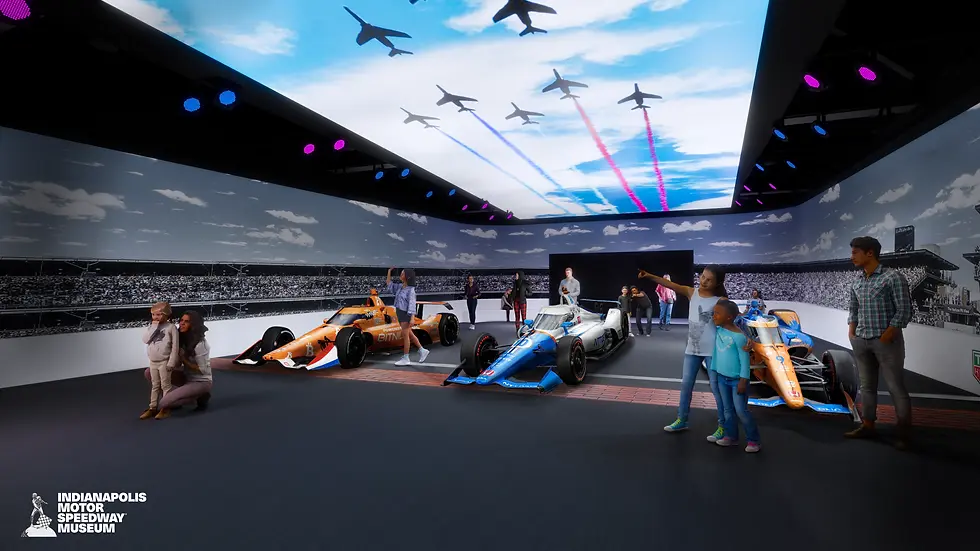
The Winners' Gallery is where it all lands. An atrium of the cars that took the coveted trophy, staged like the machines they are, each pedestal detailed to disappear so the eye goes straight to the aerodynamic line and the engineering intent. And around them, the faces. Every driver who climbed in and won, looking back at you.


Nearby, the suits and the helmets. Scarred, worn, shaped by the person who wore them. This is the closest thing to standing next to the driver who actually did it, who felt the heat and the speed and the risk, and won anyway.


That was the whole idea. Not a room full of cars behind ropes, but a sequence, the way the race itself is a sequence, building from the first slow lap to the checkered flag. Because the Indy 500 is more than a century of the same impossible bet: that a person and a machine can go a little faster than everyone thought was survivable. The names change. The drama doesn't.
Grateful to have worked on this as Production Designer, and to have helped bring this legacy to life.


Comments